Author Archives: Hermione Hoffmann
Independence for Grenada
This February, the island nation of Grenada celebrates its independence from Britain, achieved exactly 50 years ago in 1974. At Paxton House, we are very proud of our connections with Grenada and are mixing a glass of rum punch to celebrate (recipe here). Today this lush volcanic Caribbean island – the Isle of Spice – is a democratic independent nation with a rich culture of its own and a thriving economy based on tourism. Things were very different 260 years ago in 1764, when a young entrepreneur from the Scottish Borders borrowed money to buy a plantation at the north of the island. This young man was Ninian Home and, at this time, Grenada’s economy was based on slavery. Enslaved people, who had been trafficked across the Atlantic from Africa, worked plantations for their British and French overlords producing mostly sugar, the profitable crop of the era, but also coffee and cocoa. Ninian Home ‘owned’ around 200 enslaved people on his main plantation, Waltham, and others on Paraclete, which he owned in partnership. Ninian prospered in the Caribbean and, within ten years, felt able to borrow money to buy a fine house in Scotland – Paxton House – and establish himself as a British country gentleman.
Grenada in Ninian Home’s time
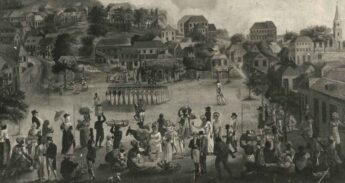
St Georges, Grenada about 1790 © Grenada National Museum
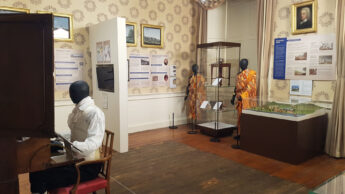
When Ninian arrived in Grenada, the island was politically volatile. It had become a British possession only a year earlier, having been ceded by France at the end of the Seven Years’ War. It was the French who had established the first plantations in the 1650s, when they conquered the Arawak-speaking Amerindian population of Caribs. The warlike Caribs had first encountered Europeans when Christopher Columbus briefly stopped on his third voyage of discovery in 1498. He named the island Conceptión but the Spanish referred to it as La Grenada; the French knew it as La Grenade; and the British as Grenada, part of the Windward Island chain which also included St Lucia and St Vincent. Today Grenada is a Tri-Island state made of Grenada, Carricaou, and Petite Martinique. As many as 130,000 Africans were brought to work the plantations on Grenada between 1669 and the abolition of the slave trade in 1807, the highest numbers during British rule when agriculture expanded from small indigo, cocoa and coffee farms to larger labour intensive sugar plantations. The enslaved people who worked the land were not freed until 1833 and remained indentured until 1838.
Grenada today
This history has given modern Grenada a rich mix of cultures – French, Spanish, British, Amerindian, African and East Indian. English is the official language but you will also hear a French-African patois. Carnival is a major celebration; steel bands and calypso are popular forms of music; storytelling is an important tradition and cricket is the national sport. Tourists make the most of the island’s pristine beaches, or trek into the lush rainforests of the interior on mountain trails. The mountains were the stronghold of the rebel leader, Julien Fédon, who led a Franco-African revolt against British rule in 1795. By this time, Ninian Home’s ambitions had led him to accept the post of Lieutenant-Governor and he was captured and executed by the rebels.
Why is Grenada important to Paxton House?
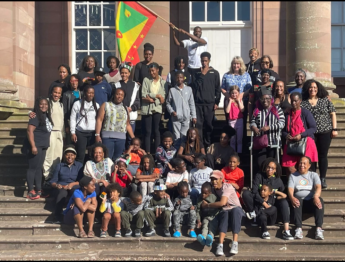 For Paxton House, the period of Ninian Home’s ownership was transformational. He and his wife, Penelope, commissioned an exception suite of interiors from the leading British makers of the period, Robert Adam and Thomas Chippendale. They visited frequently between 1774 and 1794, entertained their friends and relatives and brought with them at least two of their enslaved domestic servants, Martine and Tom. Their presence is still strong in the house and the watercolours they commissioned of Paraclete Plantation give us a rare insight into the working of an eighteenth century Grenadian sugar estate. The Home family maintained their connections with Grenada long after they ceased to own plantations in the early nineteenth century. Today we, at Paxton House, are proud to be associated with Descendants, an African Caribbean history and arts group based in London, with whom we continue a cultural exchange, helping new generations in Britain explore the legacy of transatlantic slavery. Descendants has recently celebrated 30 years since its foundation by Margaret Noel in 1993. We have been researching the history of the Grenadian plantations and recovering the identity of some of the enslaved individuals who worked there. You can discover more in exhibitions at Paxton House and online in the ‘Sugar and Slavery’ trail.
We love to welcome all visitors to Paxton House, but if anyone with a connection to Grenada pops by, please make yourself known, particularly in this 50th anniversary year of independence. Meanwhile, banish those February blues with a glass of our rum punch and raise a glass with the inhabitants of Grenada as they celebrate 50 years of independence.
Explore Paxton House’s Caribbean Connections
Get our recipe for Paxton House Rum Punch
If you are feeling sluggish after the Christmas holidays, you are not alone. You need to get outside! Outside is rarely more beautiful than the peace of Paxton House grounds in the winter. The river Tweed is glassy, still and reflective; the bare tree branches are silhouetted against the low sun and frost and snow just add a sparkle. Doesn’t that path look tempting?
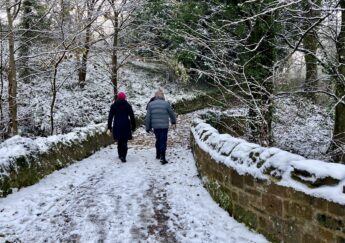
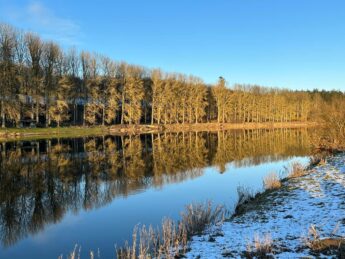 There are so many health benefits to a walk at this time of year. We all know that walking is good for your fitness but if it is cold outside you need to burn more calories than usual to keep you warm – it’s an easy win. It is muddy everywhere at this time of year and even the weight of those walking boots is adding to the effectiveness of your walk as you take our paths uphill through the woods from the river. Walking in the cold boosts your brain function so if you are working from home, it might be just what you need to up your levels of inspiration and make you feel more cheerful.
As the month progresses, you will se our gardens beginning to wake up. Already hellebores and the very first snowdrops are making an appearance. Spring won’t be far away so enjoy the winter while it’s here.
We are promoting our annual passes at Paxton at the moment so make your new year’s resolution one to visit Paxton House more often. An annual pass gives you free access to the grounds all year or a Friends’ pass gives you all sorts of discounts and free access to the house as well. It’s an easy way to support our charitable activities and get to know Paxton House better. You could take a walk here everyday. Now that would make you feel better!
Single entry grounds passes available here. Please be aware that the Stables Tearoom will not be open in January and February and the toilets are not open at weekends.
There is a strong tradition of bears around Paxton House. Visitors cannot fail to have noticed that Paxton Ted has a presence in the house and pops up at events, in artwork on the walls and even in our social media posts.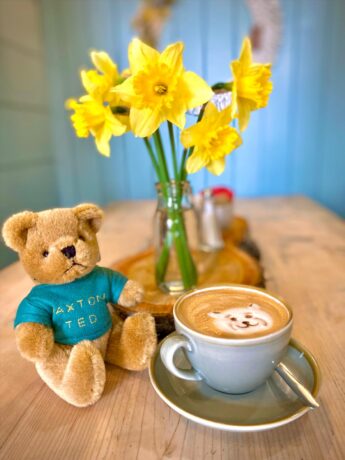 Paxton Ted has been part of Paxton House’s identity since 1997 and has become a much loved member of the team. There are other bears around here too. Once bears were hunted in the forests along the river Tweed, though probably not since the Ice Age. Berwick-upon-Tweed, our nearest town, has a bear as its symbol. Actually old English bere means barley so any association with bears must be derived from a medieval pun on the name – ‘bear’ plus ‘wych’ (the wych elm is the variety usually found in Scotland). Bear-wych, get it?! Ha ha ha! (perhaps humour has moved on a bit). You can spot the bear on the town’s coat of arms which appear on the front of the old Corporate Arms pub on
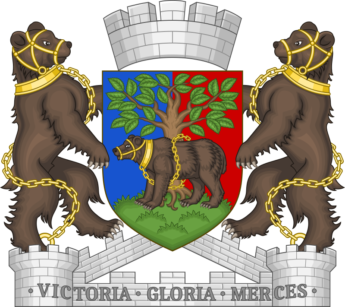 the bridge over the river Whiteadder which used to mark the limit of the town boundary.
There was a celebrity bear living just three miles from Paxton House at Winfield Airfield in the 1940s. Wojtek the Soldier Bear was a Syrian brown bear who served with the Polish army’s 22nd Transport Unit in World War II in Palestine and Italy and then in Berwickshire. He was not just a mascot, he was actually recruited as a serving soldier with his own ID papers and he performed vital work carrying 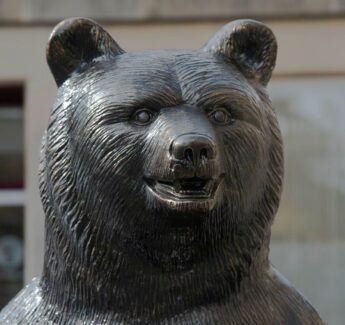 ammunition at the Battle of Monte Cassino in 1944. The Polish soldiers loved him too and used to visit him in Edinburgh Zoo when he retired there in 1947. He’d recognise them and try to cadge a cigarette or a beer, to the disapproval of the zoo keepers. Wojtek is remembered with a statue in nearby Duns and in Princes Gardens in Edinburgh. What a bear!
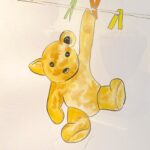
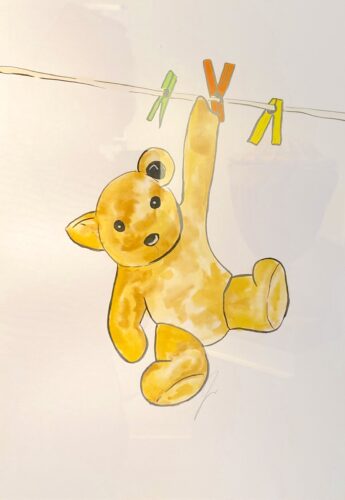
No one has put up a statue to Paxton Ted yet, but he has lots of fun peeking out at children from all the rooms at Paxton on our house tours 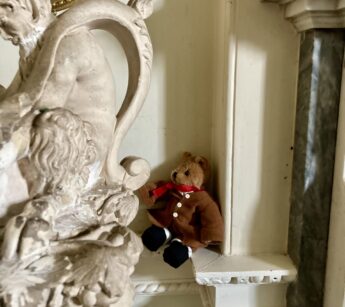 and this year he has been immortalised in watercolour by our artist-in-residence JagArt82 who will be back with some new art sessions early next year. Paxton Ted comes to life sometimes, so you have a chance of meeting him face to face at some of our events in 2024. You still have time between now and 22 December to get your own tiny Paxton Ted from the pop-up shop in the Stables Tearoom. Or maybe one of those gorgeous portraits and pop him on your wall instead. Buy a gift card for a house tour or an event next year, pop a Paxton Ted in the parcel and you have a really original gift for Christmas with something to look forward to at the end. And you can always take the kids on a bear hunt in the woodland gardens this winter……… I’m not scared….
For gift voucher options click here
Descendants and Paxton House were delighted to be awarded Creative Project of the Year for the Parallel Lives, Worlds Apart project at the Young Ealing Foundation Awards this year.
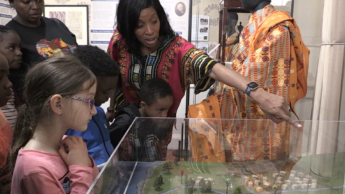
Parallel Lives, Worlds Apart was a profoundly moving and brilliant partnership project with Descendants who co-curated multiple exhibitions, events, and a workshop programme that enabled children aged 4-16 to learn about transatlantic slavery and the impact it had upon the people of Africa, the Caribbean, and the connections with past owners of Paxton House in the 18thand 19th centuries. We are very proud of the link we have established with Descendants, the African Caribbean group based in Ealing in London with whom we have enjoyed a continuing cultural exchange. Chantel Noel of Descendants feels that the children of Descendants found the project an enlightening and, for some, a life changing experience. For Paxton House, the project has significantly enriched our understanding of Paxton House’s history and its relevance in the modern world. The project was funded by the Esmée Fairbairn Collections Fund, Museums Galleries Scotland and The Textile Society. It has been recognised by both the Museums Association and Museums Galleries Scotland as an example of best practice and was shortlisted for the Museums Change Lives – Decolonising the Museum Award.
The Young Ealing Foundation Awards are about celebrating the unsung heroes of Ealing borough. The YEF Awards are co-produced with Ealing Young Champions, a group of local young people in Ealing who want to influence local decision making and ensure the voices of young people in Ealing are heard.
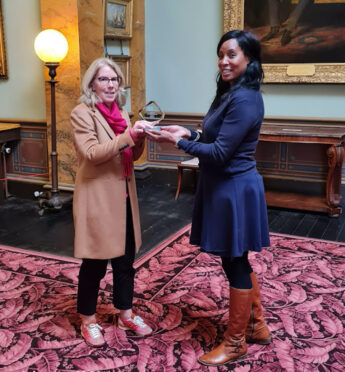
Louise Jackson, Chair of Trustees, receives the Young Ealing Foundation award trophy from Chantel Noel of Descendants
Descendants and Paxton House are looking to the future now and building upon what we have achieved to expand access to the outcomes of the project. The exhibitions Caribbean Connections, Slavery and Paxton House and Parallel Lives, Worlds Apart will be open to visitors in 2024.’ The ‘Sugar and Slavery’ trail is available online.
Chantel Noel came to Paxton House recently and, in a ceremony, presented the beautiful glass trophy to project leader and Paxton House curator, Dr Fiona Salvesen Murrell; Trustee, John Home Robertson; and Chair of Trustees, Dr Louise Jackson. John initiated the long-standing partnership with Descendants in 2007. The award is on display in the ‘Caribbean Connections, Slavery and Paxton House’ exhibition.
Descendants have close connections to the Caribbean island of Grenada where the second, third and fourth owners of Paxton owned Waltham estate (1764-1848) which produced sugar, cocoa, and coffee using enslaved African and Caribbean people. You can read more about this history here.
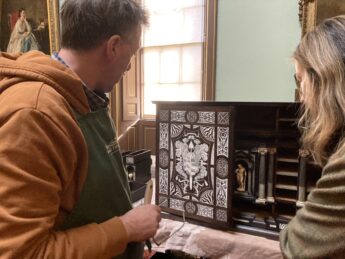
Right at the end of our visitor season in 2023, visitors to our Regency Picture Gallery were lucky enough to encounter a restoration-in-action project. Fergus Purdy, a highly skilled conservationist who has worked on parts of our collection recently with grant-funding support, was restoring The Hercules Cabinet and chatting to visitors about his work. This is one of the oldest pieces of furniture in the Paxton House collection, in fact it is nearly two hundred years older than the house itself, made between 1590 and 1620.
We are currently researching details of its history and origins but we know a little already. This beautiful rosewood and ivory cabinet was bought by Patrick Home, the builder of Paxton House, on one of his trips to Italy between 1751 and the late 1770s. Half a century later, Patrick’s cousin, George Home, who inherited it in the 1790s, commissioned a stand for it.
 The cabinet is a particularly fine example of a type which was very fashionable with the aristocratic families of Central and Northern Italy in the Renaissance. It was probably made in Naples which was a centre for this type of work. We believe it belonged to the Albertoni family of Milan and Cremona based on the coat of arms emblazoned on both doors. Cabinets of this type were designed not just for keeping precious objects, but for their display to a selected few guests of the owner. As such they conveyed clear messages about the owner’s education and knowledge of classical culture, important attributes of the Renaissance prince. Typical objects might include Greek and Roman coins and medallions, precious stones and small religious objects. Curiosities from natural history might also be included, demonstrating the Renaissance man’s curiosity about the world. Their private nature – there are a series of secret drawers in our cabinet – added cachet and further status to the sharing of the secrets of the cabinet with a few select guests. The greek hero and demi-god, Hercules, appears in an exquisite ivory statuette at the heart of the cabinet while his life and achievements are celebrated in a series of small incised plaques set into the drawers. The character of the legendary Hercules would perfectly suit a Renaissance nobleman as an architype – manly, strong and invincible.
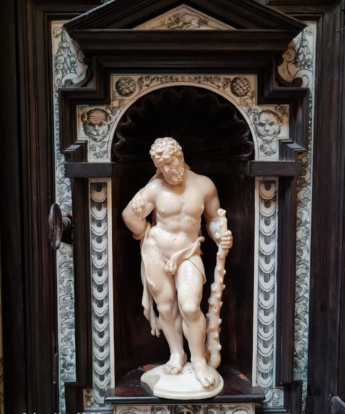
Detail of the interior of the Hercules Cabinet
In the 18th century, cabinets like this one, became highly desirable for young men on Grand Tour from Britain in search of souvenirs and objects which would prove the sophistication of their tastes when they returned home. It would have been a prized purchase for Patrick Home and an equally prized inheritance for George Home half a century later. In 1814, George corresponded with the English miniaturist George Perfect Harding about the possibility of getting a stand made. We know nothing more about the stand’s manufacture but it is made of ebony and ivory with renaissance-style grotesque patterns that pick up the design of the cabinet.
The Hercules Cabinet is now looking as good as it did when it was first made and we fully expect it to survive for another four hundred years. You can see it on a tour of Paxton House when the house reopens in April or on one of our special Behind the Scenes tours this winter.
Read more about this exciting project here.
The restoration project was made possible thanks to the Pilgrim Trust and an anonymous donation.

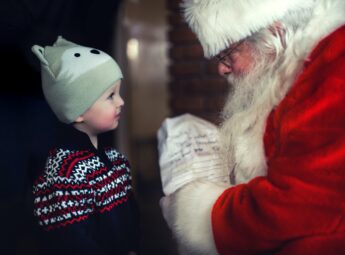
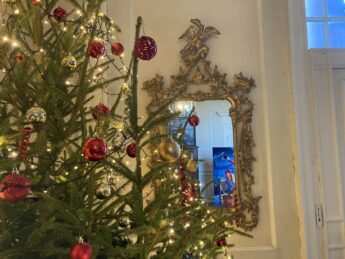 We love Christmas at Paxton House. Our elegant Georgian house will be sparkling with tastefully decorated Christmas trees and decorations that bring festive cheer in the dark days of December. We are kicking off advent with our Christmas Cracker weekend when you are welcome to come out of the cold and explore a range of stalls selling a huge range of crafts and gifts that should provide the perfect solution for all your Christmas presents and fill your Christmas stockings. There will be lots happening over the weekend with craft activities in the Hayloft Gallery for children and live music for inspiration. Advent continues with wreath making, fun for small people with Christmas Messy Play and Boogie Beats sessions. Father Christmas is stopping off on his way around the world and adults can step back in time on a special Behind-the-Scenes tour to learn about how Christmas was celebrated at Paxton in the past. All through
 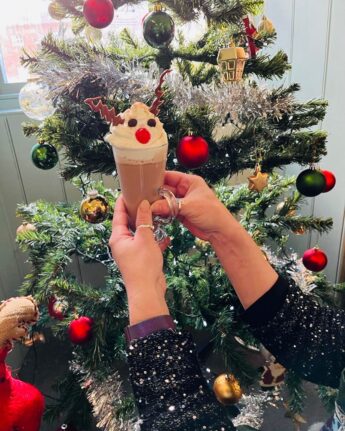 advent, the Stables Tearoom is laying on festive afternoon teas with some seasonal baking and Christmas drinks. You will need to book in advance for all events except the Christmas Cracker on 2/3 December when you can just turn up and buy tickets on the door. To round up our festive events, join us for our Christmas Carol Service on 22 December. Check our events calendar for details.
The Stables Tearoom is popular at the moment as visitors explore our gardens and muddy paths down by the river Tweed. We have a small pop-up shop in the Tearoom for small gifts and cards including the chance to give someone their very own Paxton Ted. Gift tokens are a great solution for that difficult someone, they can be exchanged for visitor tickets, used in the gift shop or for afternoon teas. It’s up to you. Just call or email to choose your price.
Explore Christmas at Paxton here. info@paxtonhouse.com
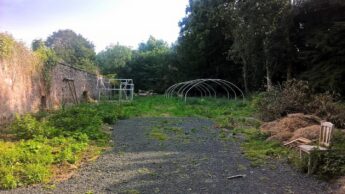
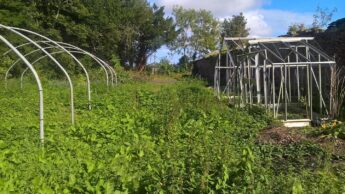
We are delighted to announce that we have received over £10,000 in funding to get going on our new community garden project at Paxton House. This has been a project close to our hearts for some time now and we have been busy fund raising to make it happen. It fits well with the Paxton Trust ethos of supporting local communities and using the outstanding grounds for public access. And we plan to make this, currently rather neglected area, beautiful again.
We plan to create an inclusive outdoor learning space open to the local community and school groups. We aim to provide new learning opportunities, a chance to enjoy nature and a place that can have a positive impact on mental health. We will even be growing some delicious and nutritious vegetables.
We hope the space will eventually become self sustainable through regular volunteer input. Mean while, if anyone has gardening tools, pots, seeds etc that you would be willing to donate, please let us know.
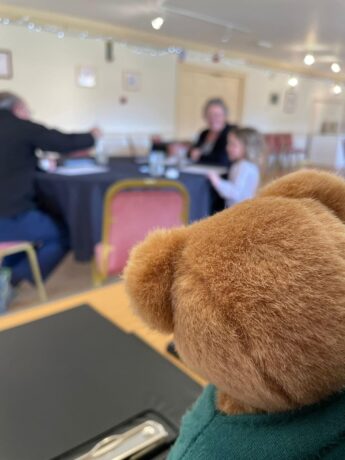 Our new Artist-in-Residence programme is off to a fantastic start. All through the October half term our new studio in the Hayloft Gallery was open to anyone who dropped in to dabble in paint and crayon. Artist James Gaffney of JagArt82 was leading fun sessions for all comers, families included, setting free artistic talent many never knew they had and giving lots of visiting families a really special day out.
James’ artist partner Ian Cowan will also be leading painting classes for all abilities on Saturdays using the beautiful Georgian house at Paxton and its parkland and gardens as backdrop for art projects. All sessions will be detailed on our events calendar so check the dates.
James has been running art programmes in Berwick-upon-Tweed to great acclaim for the past few years. He has a real rapport with children and we are delighted that he is bringing his talents to Paxton House. He is particular friend of Paxton Ted who is featuring in his sessions where you can get to know Paxton Ted better through all sorts of activities from colouring-in to original artwork. Meanwhile, James and Paxton Ted have been out and about exploring the autumn colours in Paxton’s woodland gardens. Drop-in sessions on Saturdays will be run in two hour slots and aimed at families. All materials will be provided and there is no additional charge once you have paid your entrance in the Gift Shop.
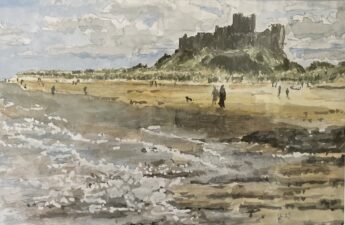
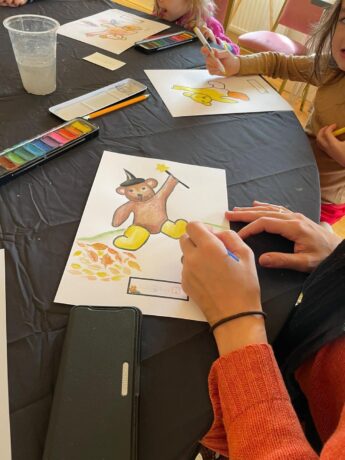 James believes that everyone should experience art personally and that Paxton House is a place which produces a powerful emotional connection. Put the two together and you have the perfect recipe for artistic inspiration with an element of wellbeing. JagArt82 have been filling the walls of Paxton House’s passages and tearoom with original artwork over the past few weeks. The whole place is looking much livelier and since these artworks are all for sale, you have the option of taking home a true original. James is full of other ideas to enrich the programme, from sessions in period costume to a secret project around the grounds, so we are looking forward to a thoroughly creative autumn and winter.
Black History Month
Two hundred and fifty years ago, on 20 August 1773, a sixteen-year-old boy was baptised as ‘John Stuart’ in London at St James’s Church, Piccadilly. Why is this important? That boy’s birth name was Quobna Ottobah Cugoano and he became one of the great anti-slavery campaigners of 18th century Britain, calling for total abolition of the slave trade in the British Empire. Paxton House’s curator, Dr Fiona Salvesen Murrell tells his story.
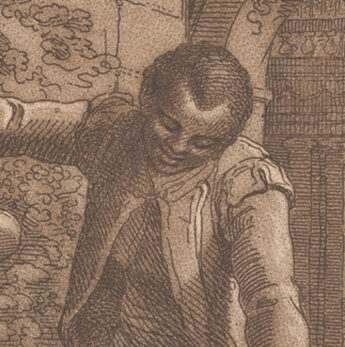
Ottobah Cuguano, detail of a portrait engraving by Thomas Rowlandson, 1784
Why is this baptism relevant to Paxton House? As Cugoano himself related, he had been bought by Alexander Campbell (1739-1795)[i] on the
Caribbean Island of Grenada and was brought by Campbell to Britain as his personal servant in 1772. On board the same ship were Campbell’s close friends, Ninian and Penelope Home, owners of Waltham plantation in Grenada. The Home’s shared part-ownership of Paraclete plantation in Grenada with Campbell and remained close friends during their lifetimes. Prior to, during and after this voyage, Cugaono was in very close proximity to the Homes and his master and enslaver. This was Cugoano’s second transatlantic voyage; the first had been from Ghana in West Africa to Grenada, around two years earlier, at the age of thirteen.
Cugoano had been playing in the forest with friends when they were kidnapped by African men. The children were separated over their journey to the coast and Cugoano was taken and sold at a coastal fort where the terrible reality of what was happening to him was evident with the brutality he witnessed. He was put on board a slave ship and, unlike many others, Cugoano survived the horrific conditions on board. Such was their misery, that the women and children with the agreement of the male enslaved people, who were almost constantly in chains below deck, plotted to set the ship on fire to end all their lives rather than continue. This was foiled and Cugoano was brought ashore in Grenada and worked as a field slave initially. He was one of around 12.5 million Africans trafficked across the Atlantic Ocean, of whom around two million died en-route, to endure a life of brutality on colonial plantations. Cugoano wrote:
“Being in this dreadful captivity and horrible slavery, without any hope of deliverance, for about eight or nine months, beholding the most dreadful scenes of misery and cruelty, and seeing my miserable companions often cruelly lashed, and as it were cut to pieces, for the most trifling faults; this made me often tremble and weep, but I escaped better than many of them.”[ii]
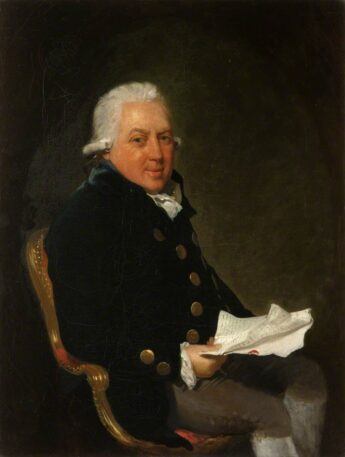
Portrait of Alexander Campbell of Grenada by an unknown artist
On this transatlantic journey, from Grenada to England, as an enslaved servant, Cugoano would not have been confined to the hold, but the horrors of what he had endured previously must have been very fresh in his mind. The ship landed at Portsmouth on 15th July 1772 and the Homes, Campbell and Cugoano travelled to London. Prior to, during and after this voyage, Ninian was unwell with an illness that caused ‘dysentery’ and was sent by a doctor to Scotland to recover. Ninian and Penelope arrived at Wedderburn Castle, owned by Ninian’s uncle, Patrick, on 18thAugust.[iii] [iv]
At the same time, or shortly afterwards, in late 1772, Campbell came to visit Ninian and Penelope Home at Paxton House which the couple had previously rented. It would have been unthinkable for Campbell to have left Cugoano somewhere else as he was viewed as a valuable young servant, so Cugoano would have accompanied his master and stayed at Paxton. Cugaono, as Campbell’s personal servant, was likely to have been dressed in smart clothing to show off his master’s wealth and status.
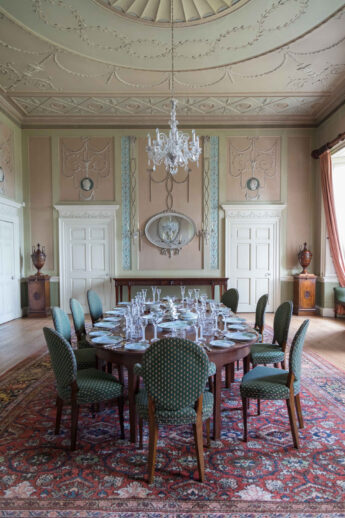
The Dining room at Paxton House. Only the dining room table was in the room when Ottobah Cuguano visited.
Their stay coincided with the time that Ninian and Penelope were negotiating with Ninian’s uncle Patrick on the sale price of Paxton. Paxton must have had rented furniture in it at the time, as the commissions for the furniture supplied by Thomas Chippendale had not yet begun. The likeliest item that is still in place today was the dining table which was there before 1774. Can you imagine what it was like for Cugaono living at Paxton House then?
Paxton may have been the first grand country house Cugaono had entered in Britain. The interiors in 1772 were still unfinished in parts (the Drawing Room, for instance, wasn’t furnished until 1789-91), and probably contained limited amounts of rented furniture. The land around the House was still being landscaped and any trees were probably quite small.
Cugaono would have met the local Scottish servants employed by the Home family. How they treated him and what he made of them is unknown. We don’t know if Ninian and Penelope also brought enslaved servants with them to Scotland at this point in time; however, in 1788 the family archives reveal that they brought two enslaved servants from Grenada to Paxton: Tom, Ninian’s valet, and Martine, Penelope’s maidservant.
By that point, the Knight vs. Wedderburn court case had been held in Scotland (in 1778) and it found that slavery was not a condition recognised in Scotland. However, this was not widely known, and unless an enslaved person brought to Scotland was made aware of this recent ruling, they were unlikely to be able to leave their ‘owner’ for good. Adverts in the British newspapers of the time commonly described an enslaved runaway’s appearance and clothing, to get them recaptured.
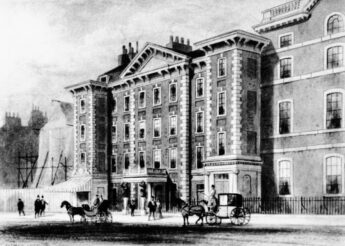
Schomberg House, where Cuguano lived with the Cosway family. From an 1850 engraving.
In England, the Somerset case, in 1772, ruled that, ‘a master could not seize a slave in England and detain him preparatory to sending him out of the realm to be sold’. It also ruled that habeas corpus was a constitutional right available to slaves to forestall such seizure, deportation, and sale, because they were not chattel, or mere property – they were servants and thus persons invested with certain (but limited) constitutional protections.[v] Somerset winning his freedom led to around 200 Black people in London gathering to celebrate in a public house in Westminster which culminated in a Ball.
Cugaono and Campbell travelled to London after their visit to Scotland. Cugaono wrote that his master supported him in learning to read and write by sending him to a school. Cugoano obtained his freedom and left Campbell’s service. His baptism at St James’s Church, Piccadilly, must have been a truly momentous occasion for Cugoano and he came became deeply religious. (St James’s is currently commemorating this anniversary with a series of events.)
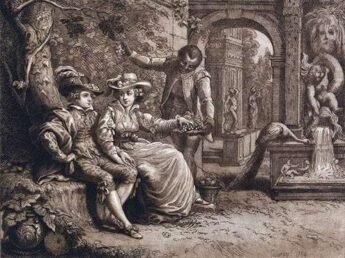 The next that is known about Cugoano’s life is that he was employed by 1784, or earlier, and until c.1791 in service of the artists, Richard and Maria Cosway. Maria strongly supported female education, and had trained under Zoffany, Batoni, and several other prominent Italian and British artists in Italy in the 1770s. She exhibited at the Royal Academy. Richard, her husband, was a celebrated miniature painter. The Cosways lived at 81 Pall Mall, London, part of Schomberg House. Their social circle included many artists, musicians, writers, politicians, and royalty, in the form of the Prince of Wales. Cugoano was therefore in the midst of this extraordinary household and evidently was able to converse with many of the people he met. Cugoano was portrayed in 1784 by famous artist, Thomas Rowlandson, in a triple portrait engraving of Cugoano with Richard and Maria Cosway (this engraving was formerly attributed to Richard Cosway).
Cugoano is not subservient in this portrait, contrary to many depictions of Black people in other European works of art. An early biographer of Cosway recounted that Cugoano was attired “in crimson silk with elaborate lace and gold buttons, and, later on, in crimson Genoa velvet, in imitation of the footmen at the Vatican.”
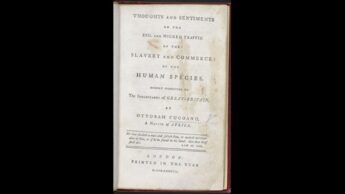 In 1787, the year before Tom and Martine came to Paxton with Ninian and Penelope Home, Cugaono published his seminal book, Thoughts and Sentiments on the Evil and Wicked Traffic of the Slavery and Commerce of the Human Species, humbly submitted to the inhabitants of Great-Britain, by Ottobah Cugoano, a native of Africa. His publication was sent to King George III and other influential British figures, such as the politician, Edmund Burke. Cugoano was supported by some of the artists in the Cosways’ circle, including Sir Joshua Reynolds, President of the Royal Academy, James Northcote, Joseph Nollekens, and Richard Cosway, who subscribed to the second edition of Cugoano’s book.
In this book, Cugaono described his early life and status, and his capture in the forest near his home in the Fante village of Agimaque or Ajumako in what is now modern-day Ghana.
“I was born in the city of Agimaque, on the coast of Fantyn; my father was a companion to the chief in that part of the country of Fantee, and when the old king died I was left in his house with his family; soon after I was sent for by his nephew, Ambro Accasa, who succeeded the old king in the chiefdom of that part of Fantee known by the name of Agimaque and Assinee. I lived with his children, enjoying peace and tranquillity, about twenty moons, which, according to their way of reckoning time, is two years.
I was sent for to visit an uncle, who lived at a considerable distance from Agimaque. The first day after we set out we arrived at Assinee, and the third day at my uncle’s habitation, where I lived about three months, and was then thinking of returning to my father and young companion at Agimaque; but by this time I had got well acquainted with some of the children of my uncle’s hundreds of relations, and we were some days too ventursome in going into the woods to gather fruit and catch birds, and such amusements as pleased us. One day I refused to go with the rest, being rather apprehensive that something might happen to us; till one of my play-fellows said to me, because you belong to the great men, you are afraid to venture your carcase, or else of the bounsam, which is the devil. This enraged me so much, that I set a resolution to join the rest, and we went into the woods as usual; but we had not been above two hours before our troubles began, when several great ruffians came upon us suddenly, and said we had committed a fault against their lord, and we must go and answer for it ourselves before him.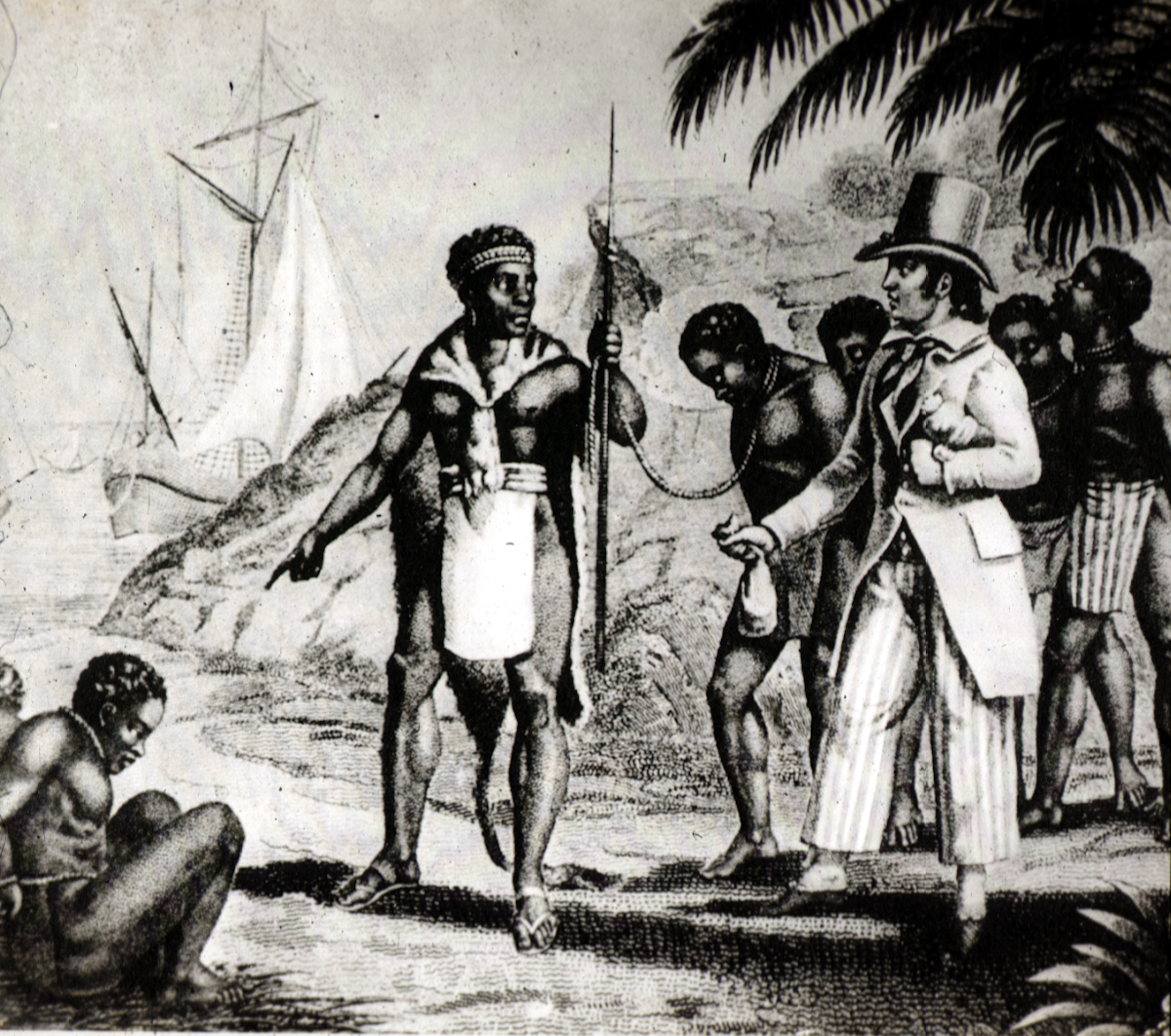
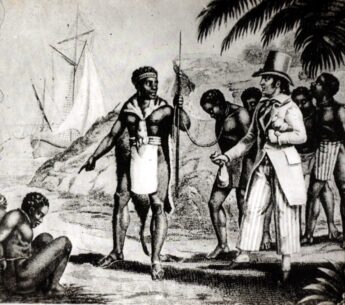
African Merchant Selling Slaves to a European from Isabelle Aguet, A Pictorial History of the Slave Trade (Geneva, 1971)
Some of us attempted in vain to run away, but pistols and cutlasses were soon introduced, threatening, that if we offered to stir we should all lie dead on the spot. One of them pretended to be more friendly than the rest, and said, that he would speak to their lord to get us clear, and desired that we should follow him; we were then immediately divided into different parties, and drove after him….”
After around two weeks of travel and trickery, they came…
“…to a town, where I saw several white people, which made me afraid that they would eat me, according to our notion as children in the inland parts of the country. This made me rest very uneasy all the night, and next morning I had some victuals brought, desiring me to eat and make haste, as my guide and kid-napper told me that he had to go to the castle with some company that were going there, as he had told me before, to get some goods. After I was ordered out, the horrors I soon saw and felt, cannot be well described; I saw many of my miserable countrymen chained two and two, some hand-cuffed, and some with their hands tied behind. We were conducted along by a guard, and when we arrived at the castle, I asked my guide what I was brought there for, he told me to learn the ways of the browfow, that is the white faced people. I saw him take a gun, a piece of cloth, and some lead for me, and then he told me that he must now leave me there, and went off. This made me cry bitterly, but I was soon conducted to a prison, for three days, where I heard the groans and cries of many, and saw some of my fellow-captives. But when a vessel arrived to conduct us away to the ship, it was a most horrible scene; there was nothing to be heard but rattling of chains, smacking of whips, and the groans and cries of our fellowmen. Some would not stir from the ground, when they were lashed and beat in the most horrible manner…
From the time that I was kid-napped and conducted to a factory, and from thence in the brutish, base, but fashionable way of traffic, consigned to Grenada, the grievous thoughts which I then felt, still pant in my heart; though my fears and tears have long since subsided. And yet it is still grievous to think that thousands more have suffered in similar and greater distress, under the hands of barbarous robbers, and merciless taskmasters; and that many even now are suffering in all the extreme bitterness of grief and woe, that no language can describe. The cries of some, and the sight of their misery, may be seen and heard afar; but the deep sounding groans of thousands, and the great sadness of their misery and woe, under the heavy load of oppressions and calamities inflicted upon them, are such as can only be distinctly known to the ears of Jehovah Sabaoth.”
In 1787, when Cugoano published his seminal book, he wrote, describing the West-India slaves;
“For the slaves, like animals, are bought and sold, and dealt with as their capricious owners may think fit, even in torturing and tearing them to pieces, and wearing them out with hard labour, hunger and oppression; and should the death of a slave ensue by some other more violent way than that which is commonly the death of thousands, and tens of thousands in the end, the haughty tyrant, in that case, has only to pay a small fine for the murder and death of his slave.”
Cugoano argued for enslaved people to be given their liberty and freedom. He pointed out the false narratives used by those prolonging enslavement:
“Some pretend that the Africans, in general, are a set of poor, ignorant, dispersed, unsociable people; and that they think it no crime to sell one another, and even their own wives and children; therefore they bring them away to a situation where many of them may arrive to a better state than ever they could obtain in their own native country.”
Cugoano’s publication was the first book written by an African to demand the total abolition of the slave trade in the British Empire. His powerful account of his first-hand experiences and Christian rhetoric against slavery lent great weight to the abolition movement.
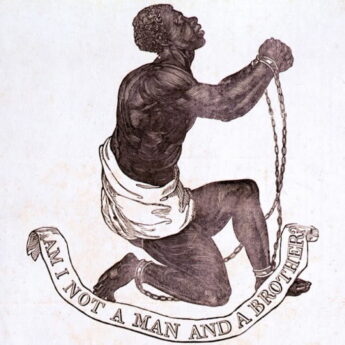
“Am I not a man and a brother?” the symbol of the abolition movement of the late eighteenth century in Britain.
In the 1780s, around 20,000 people in Britian were Black, out of an overall population of 5 million. Many lived in London and during this decade several Black writers and activists got together and called themselves the ‘Sons of Africa’. Cugaono was an important member of this campaigning group whose other members were; Gustavus Vassa, George Robert Mandeville, William Stevens, Joseph Almaze, Broughwar Jogensmel [Jasper Goree], James Bailey, Thomas Oxford, John Adams, George Wallace, Yahne Aelane [Joseph Stuart], Cojoh Ammere [George Williams], Thomas Cooper, William Greek, and Bernard Elliot Griffiths. The Sons of Africa sought to make known the horrors of the transatlantic slave trade and to abolish the institution of slavery in the British colonies. They were deeply involved in the anti-slavery movement and worked intimately with the Society for the Abolition of the Slave Trade, a non-denominational group founded in 1787 by Granville Sharp and Thomas Clarkson.[vi]
In 1786, Cugoano managed, with the help of William Green and Granville Sharp, to prevent Henry Demane, an African who had been kidnapped by slave-traders, from being shipped from Britian to the West Indies. In 1790, Cugoano, must have been aware that his former enslaver, Alexander Campbell, was representing West India planters in giving evidence to support the continuation of the transatlantic slave trade in Parliament. Cugoano disappears from the historical records after 1791, but his presence at Paxton and his efforts to end slavery have certainly not been forgotten.
Notes:
[i] Campbell was a Scot, from Islay, who became a merchant and enslaver in the Caribbean. Shortly after the Treatise of Paris, in 1763, (when Grenada became a British colony) Campbell borrowed £40,000 from his relations to purchase two plantations in Grenada with nearly 300 enslaved people. He later owned up to fourteen plantations and acted as a spokesman for West Indian planters in London. He was captured and killed in the Fedon Uprising in Grenada, along with Ninian Home, in 1795.
[ii] Ottobah Cugoano, Thoughts and Sentiments on the Evil and Wicked Traffic of the Slavery and Commerce of the Human Species,(London, 1787).
[iii] National Records of Scotland (NRS), GD267/22/7 Letter from George Home to Patrick Home (Naples), 27 July 1772
[iv] NRS, GD267/22/7, Letter George Home to Patrick Home (Rome) 27 August 1772
[v] https://www.english-heritage.org.uk/visit/places/kenwood/history-stories-kenwood/somerset-case/
[vi] https://equianosworld.org/associates-abolition.php?id=2
Rebecca Olds, postgraduate student at the University of Glasgow, shares her discoveries about the wardrobe owned by Ninian Home in 1795 using evidence from the Home Family archives.
In 1795, Ninian Home, the owner of Paxton House, met with a violent death in one of Britain’s colonies in the Caribbean, Grenada, where he had been serving as Lieutenant-Governor since late 1792. Ninian, along with about 50 other British plantation owners, sailors, and others, was captured in Fédon’s Uprising against British rule in Grenada. He was executed by the freedom fighters on 8 April 1795 and, during the course of the uprising, his plantation, Waltham, was sacked. See Caribbean Connections.
Original inventory of Ninian Home’s possessions, 1795
Shortly after Ninian’s death in Grenada, an inventory was taken of his possessions there. This document survives in the Home Robertson family records at the National Records of Scotland, offering a rare glimpse into the life of a Scot living in the Caribbean in the closing years of the eighteenth century. The inventory lists the contents of two trunks containing “Wearing apparel”. Each garment is identified by name. With a few exceptions, these are all garments that men back in Britain would have recognised in their own wardrobes. This article will highlight how Ninian conformed to social norms in his attire, while also using fabric choices to adapt items in his wardrobe to better suit his lifestyle as a planter in the warm, humid climate of the Caribbean.
Three piece suits
The backbone of a man’s wardrobe in the 18th century was the three-piece suit of the time, consisting of a coat, waistcoat, and breeches. By the 1790s, having a suit with all three pieces made from the same matching fabric was no longer fashionable, and Ninian’s wardrobe reflects the flexibility of a more mix-and-match approach rather than fixed ensembles. He owned 7 coats, 27 waistcoats and 24 pairs of breeches in Grenada. In a business or social setting, he may have presented himself in an ensemble similar to this one:
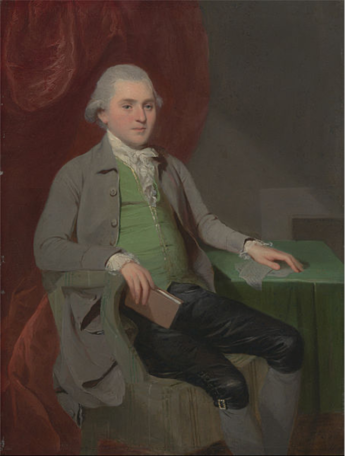
An Unknown Man by John Downman c. 1780 © Yale Center for British Art, Paul Mellon Collection.
Woollen fabrics made up the backbone of a British gentleman’s wardrobe in the 18th century and Ninian’s inventory includes outer garments like waistcoats and breeches that were made of “flannel” and “cloth”, both of which were types of wool. But Ninian also had breeches made of corduroy, which was, back then just as now, a hardwearing yet comfortable fabric. Back in Scotland, Ninian might have chosen leather breeches, especially for riding on horseback. But in Grenada, corduroy was a cooler, more breathable option, perfect when outdoors overseeing construction projects on the plantation and directing enslaved workers in the fields.
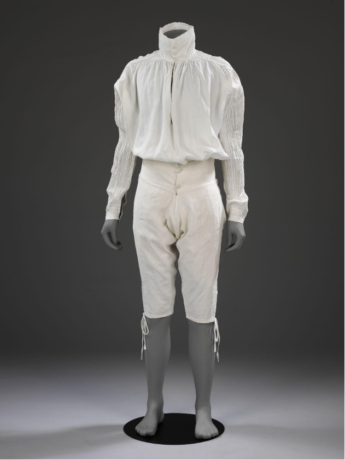
Linen shirt, 1740-1780, & drawers, 1775-1800, © Victoria & Albert Museum
Underneath his suits of clothes, Ninian wore the underwear of the day: shirts and drawers made of linen or cotton. For much of the eighteenth century, shirts alone served as the main item of body linen for British men, protecting the skin from outer clothing, and likewise clothing from the sweat and oils of the body. By the end of the century, drawers began to feature a bit more in clothing inventories, especially in warm climates where drawers served as a washable barrier, a kind of changeable lining to the breeches being worn. Body linens like shirts and drawers were laundered after every wear, while outerwear was not. The domestic servants in Ninian’s house, whether free or enslaved, knew how to keep his coats, waistcoats and breeches fresh and presentable by airing them out, brushing off any loose dirt and treating stains with an appropriate spot cleaner. Meanwhile, after a hot day of doing paperwork or walking the fields, Ninian could simply change his underwear – from a supply of 40 shirts and 10 pairs of drawers – to feel fresh as a daisy again!
As the case with other men of his station back in Britain, Ninian had many pairs of stockings. The inventory lists at least 89 pairs! Of these, 15 were cotton, 10 were ‘thread’ (made from yarns spun from flax, the same plant fibre that produced linen fabric), possibly as many as 38 were silk and another 35 were worsted (from yarns finely spun from sheep’s wool). Stockings in the 18th century were long enough to come up to a man’s knees and tuck in under the knee bands of his breeches. Most stockings in the 18th century were knitted with a frame knitting machine and most if not all of Ninian’s were probably sourced from Britain, particularly as Scotland had a thriving industry in producing knitted stockings.
Adapting to the Caribbean
Looking at the textiles or fabrics that Ninian’s garments were made of gives us more insight into life on the Caribbean plantations. The inventory did include garments made of the same fabrics as were in his wardrobe at Paxton House in Scotland, but also included garments of textiles especially well-suited to the Caribbean climate, which his contemporaries back in Scotland were not wearing, or at least, not so often.
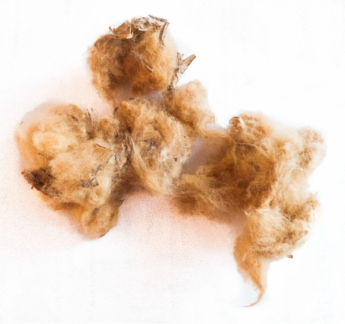
Chinese nankeen cotton in its natural state © Neal Hurst
Wools and silks would have featured heavily in Ninian’s wardrobe at Paxton House, but these fabrics were much too hot for everyday wear in the Caribbean. The inventory reveals that, as well as “flannel” and “cloth” breeches mentioned above, Ninian owned, at the time of his death, five pairs of breeches made of “nankeen”. Nankeen was a cotton grown in China that was naturally a golden colour. It became so popular that cotton merchants and manufacturers in Manchester began dyeing white cotton grown in Britain’s colonies a similar shade of yellow and marketing it as “nankeen” as cheap competition against the ‘real thing’ from China.
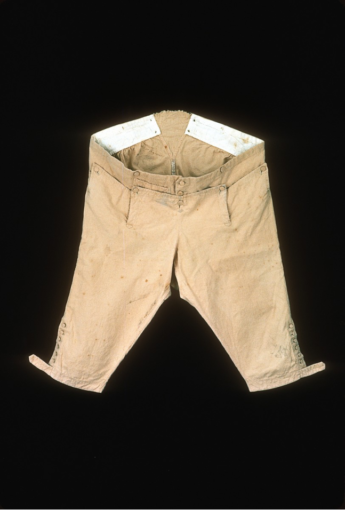
Breeches, 1770-1810, nankeen cotton © Colonial Williamsburg
Whether Chinese or American, nankeen cotton was ideal for making tough, lightweight, comfortable breeches worn in the Caribbean and the southern American colonies, such as the pair pictured left.
As well as clothing, the inventory lists large quantities of fabric that Ninian considered necessary for caring for the needs of everyone he took responsibility for, including servants and enslaved people. Many of the textiles he owned were suitable for multiple uses, from clothing to household linens and furnishings. Ninian owned nearly 100 yards of cotton “diaper” and 45 yards of “fine striped Dimity”. Both diaper and dimity were types of fabrics made of cotton or linen that had patterns woven into them. Scotland produced several types of diaper in the 18th century. Ninian imported goods directly from Scotland in a variety of ways: via ships in which he owned shares, by placing orders through captains of other ships that delivered supplies from Scotland, and by ordering goods from London merchants who in turn sourced fabrics from Scotland.

18th century diaper fabric, private collection
Diaper featured small, even repeating patterns of geometric shapes such as diamonds, rectangles or square. Its use is well-documented for summer clothing, especially waistcoats and breeches.
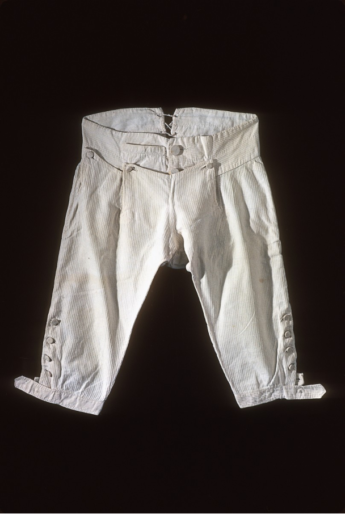
Breeches,1765-1785, white cotton and linen dimity © Colonial Williamsburg
Dimity was a lightweight fabric made of cotton, linen or a mixture of the two, with raised stripes or cords running lengthwise through the cloth. The weave produced a striped effect that could be both seen and felt. An example of breeches made from a cotton/linen mix dimity, used as summer wear, is pictured left.
Ninian had a variety of clothing items made from calico and cambric. The name “calico” (sometimes spelled with an ‘e’ at the end) came from the city of Calcutta and was used as an umbrella term for a huge range of cottons of every quality that were produced in India. One trunk contained 34 shirts made of calico and another had three pieces of calico designated as wrappers. The shirts were no doubt of considerably finer calico than the calico used for wrapping goods or cargo. Cambric was even finer than calico shirt material, but it was linen, not cotton. In France, cambric was called batiste, a textile term that is still in use today for a very fine cotton rather than linen.
While it is fascinating to see what Ninian had in his wardrobe in Grenada as a way of understanding his life there, it is also interesting to notice that, for whatever reason, the inventory did not include hats or trousers.
Trousers certainly existed in the period but back in Britain they tended to be worn as a kind of cover-all, worn over breeches when working. They were understood as being workwear and not fashionable but this was beginning to change in the 1790s. Gentlemen turned to wearing trousers when out in the Caribbean more readily than they did in Britain and the rest of Europe, as a cooler alternative to breeches. The illustration below depicts a French plantation owner wearing trousers on his Caribbean plantation.
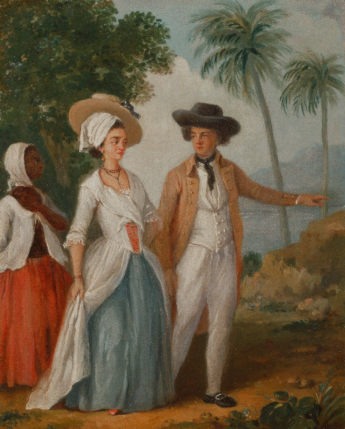
Agostino Brunias (1728-1796), Planter and his Wife, with a Servant, circa 1780, © Yale Center for British Art.
As for hats, we do not know why no mention of them is made in the inventory, but it is almost inconceivable that Ninian might not have owned any. The painting of Ninian on his Paraclete plantation in Grenada, below, certainly shows him wearing a large-brimmed hat. From this painting, we can also see that Ninian dressed according to his status and identity as a British businessman and gentleman, while the inventory tells us that he adapted his wardrobe as needed for ease and comfort in the hot, humid Caribbean climate.
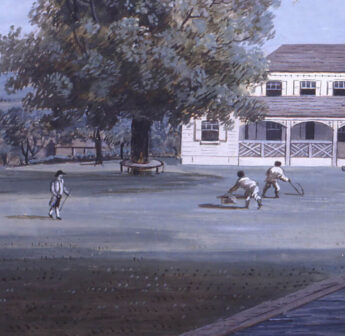 Header image: Adam Callander (1750-1817), A View of the Paraclete Estate House, Grenada [detail], 1789, gouache on paper, The Paxton House Trust
Download the original inventory here, a transcript here. Other archival records relating to slavery can be accessed here.
 Rebecca Olds is a postgraduate student enrolled on the MLitt Dress and Textile Histories course at the University of Glasgow. She is currently writing her dissertation exploring why elite women in the Scottish Highlands desired to have gowns made of fashionable London silks in the early 18th century. Rebecca hopes to continue her research through PhD studies, focusing on women’s participation in the garment-making trades in the Scottish Highlands during the 18th century. She was involved in Paxton House’s Georgian Dressmaking Live! event in Spring 2023. The sackback gown she helped to make as part of that event in currently on display in the dining room. To see it, book a house tour here.