Author Archives: Hermione Hoffmann
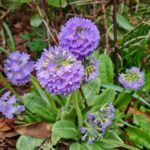
Now it is May, the candelabra primulas are a must see in the gardens at Paxton House. Their distinctive lollipop heads and cheerful bright colours bring the first feel of summer and warm days to come. If you walk down through the Well Garden, you will see them gathered in groups at the edges of the stream and popping out of the foliage at the side of the path. They thrive in the hummus-rich semi shade on the south-facing slopes above the Tweed and have formed naturalised clumps of pinks and purples that can’t help but bring a smile to your face. We work hard dividing our mature plants in the early Spring so that there are lots of pots of primulas for visitors to buy in our plant shop. Proceeds from sales of our plants are used to fund new planting each year so we really appreciate your purchases. Now is the time to take a little colour home for your garden
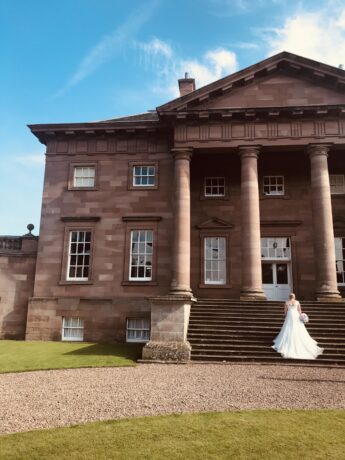 May is traditionally the start of peak wedding season, after all, the weather is likely to be warm, sometimes even warm enough to be married outdoors, California-style.
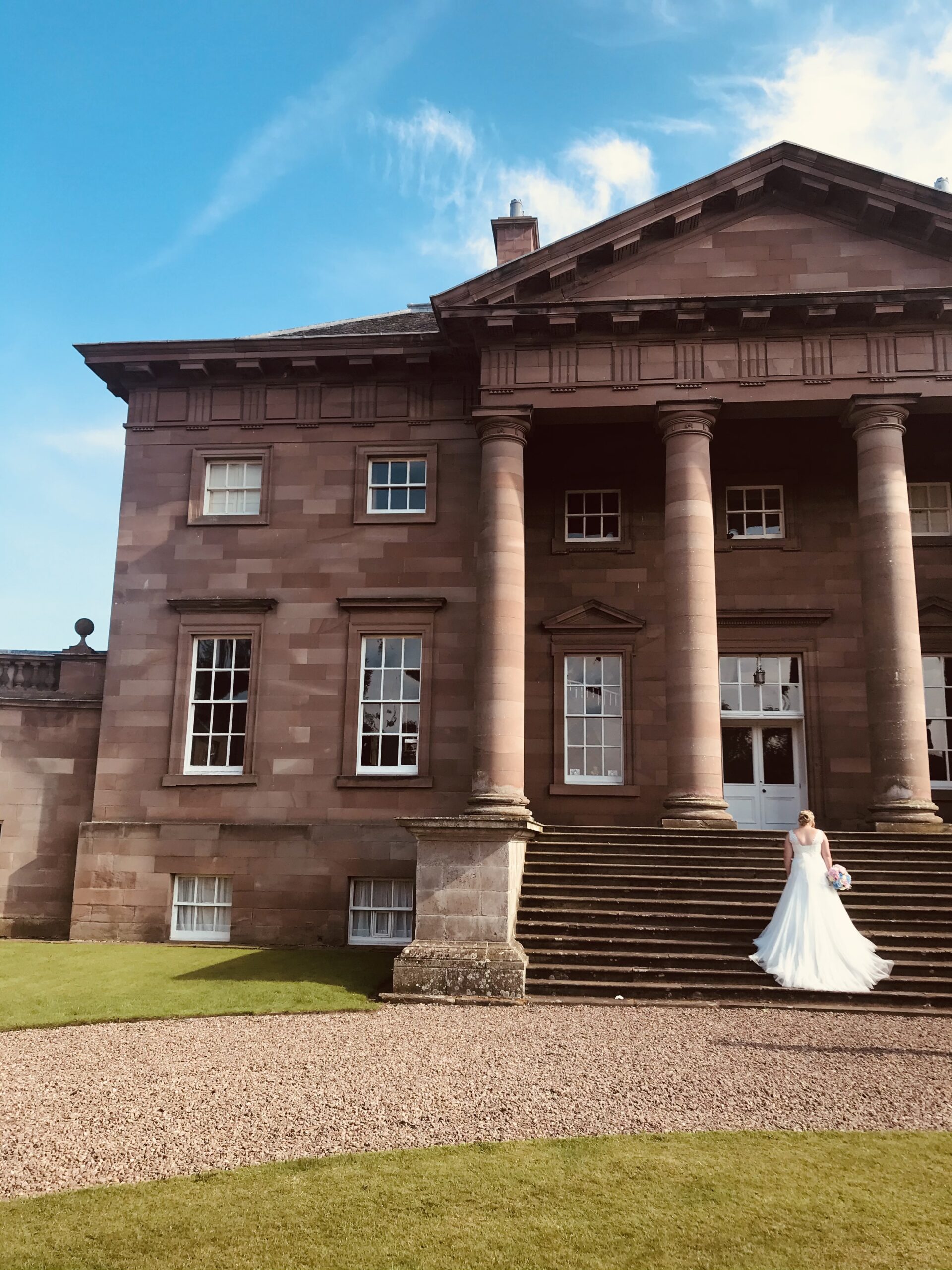
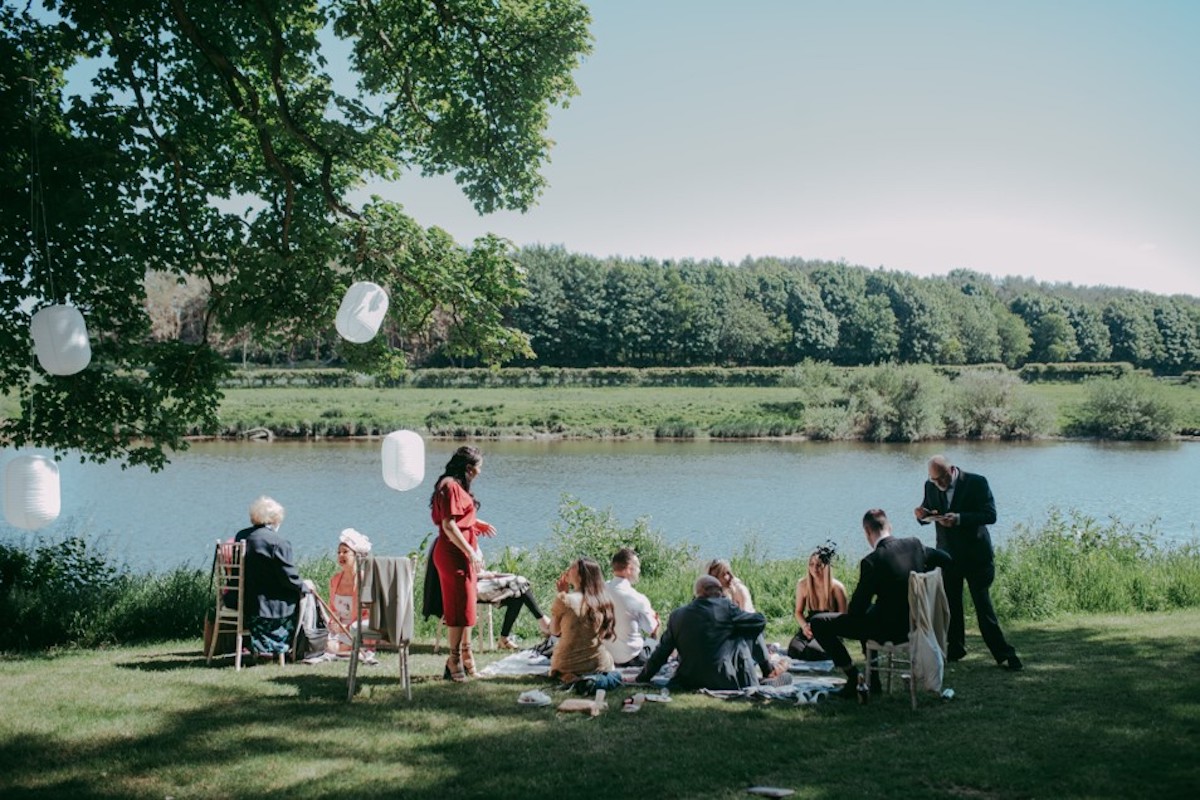
Many of our visitors will have noticed that Paxton House is increasingly a popular wedding venue, inviting couples into our special world to ‘tie the knot’ on the England Scotland border. The graceful classical house is a romantic place not just because of its beauty as a setting and the way a bride looks climbing the steps of the portico but because the house itself was inspired by love when young Patrick Home of Billie fell in love with Prussian heiress, Sophie de Brandt. For nature lovers, the banks of the river Tweed where the green riverside meets the blue water, have an irresistible informal romance of their own where dappled shadows pattern the ground and you feel as if time has stopped.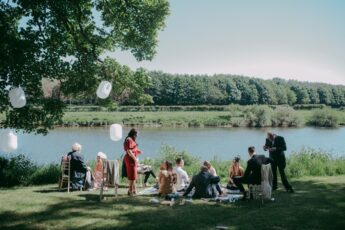
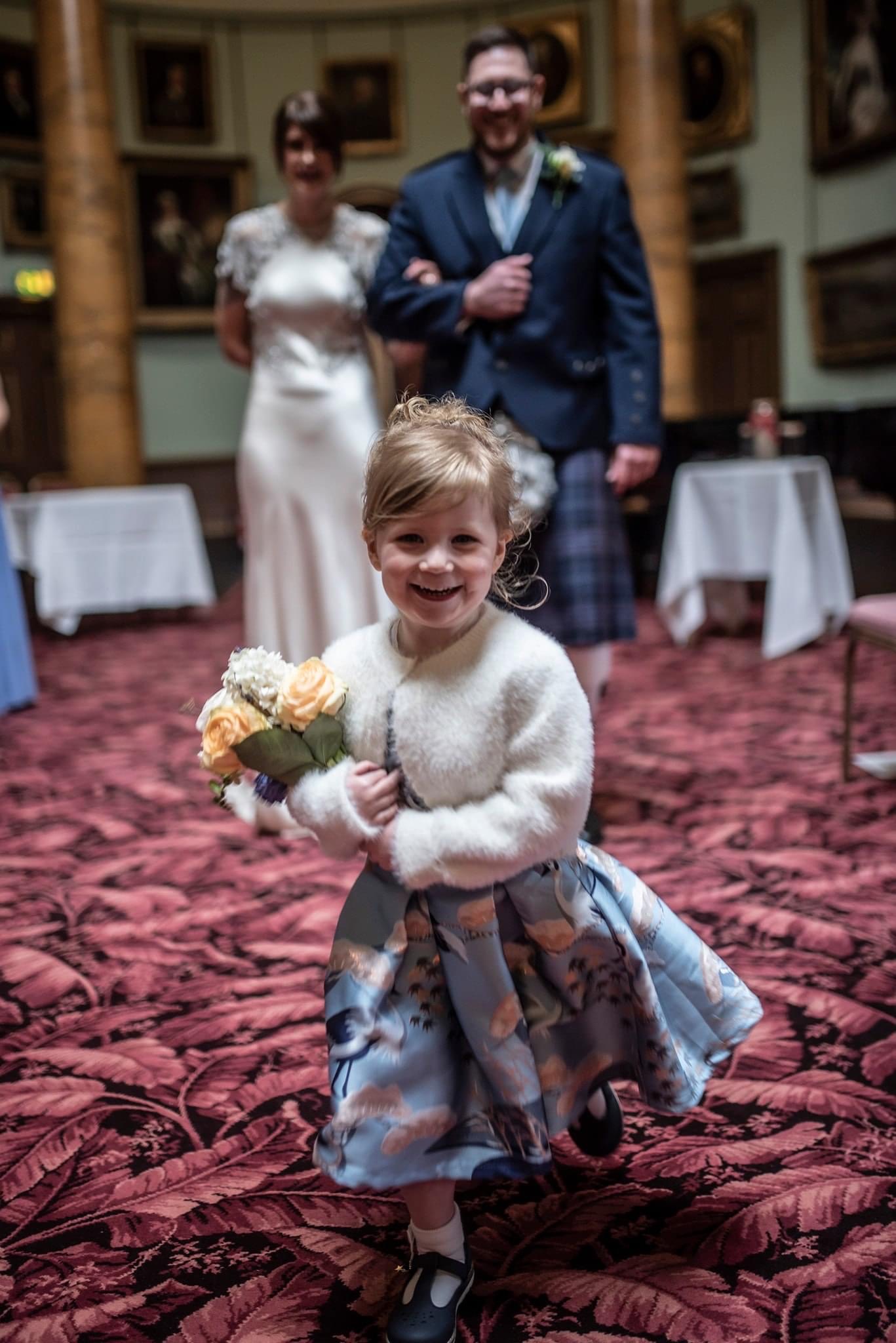
There have been some changes in the way couples marry in the past few years. Bridebook report the latest in wedding habits for 2024 and marrying outdoors seems to be top of the list. At Paxton, we can certainly confirm that our brides and grooms are enthusiastically embracing some of the variety that we offer. Our dedicated wedding planning team really enjoy reflecting each bride’s individuality and happily embrace unusual choices. Dogs – or even alpacas – at the centre of the guest list are no surprise to them and Paxton House is the only place we know where you can include Celtic marriage traditions in your ceremony and even exchange vows on the water in a traditional Tweed coble. The increase in bookings for our small Victorian boathouse on the river speaks to a move towards smaller, more intimate weddings with rustic charm. Outdoor weddings are also being held on the spacious lawns on the Garden Front of Paxton House. Don’t worry, we offset the risk of Britain’s notoriously fickle weather turning against you with a backup 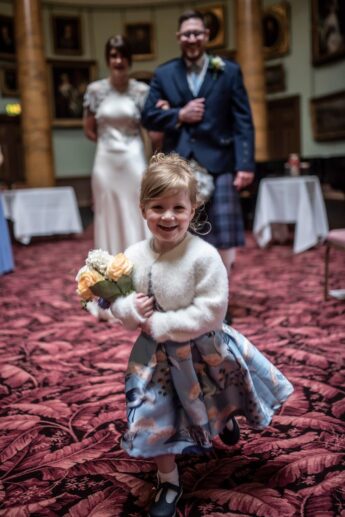 arrangement in the marquee. The marquee is cleverly sited so that guests can have drinks on the lawns that overlook the Union Chain Bridge and works as a stand alone venue or more often as the relaxed party space for a wedding that starts in the grandeur of the main house. We’ve just posted a new video on our weddings page, kindly provided by one of last year’s happy couples, that should really inspire anyone looking for the perfect historic house wedding venue.
Something we love about weddings held at Paxton House is that, very often, the house and grounds become a part of the lives of our couples. If you start your life together by staging a proposal or getting married in the grounds at Paxton (or both), it seems that returning on anniversaries or to introduce the house to your children is an important part of your continuing romance. Those long term relationships are very special to us.
We are looking forward to a busy wedding season and we believe that Paxton House is the perfect place to celebrate love this summer.
Explore all our wedding venues.
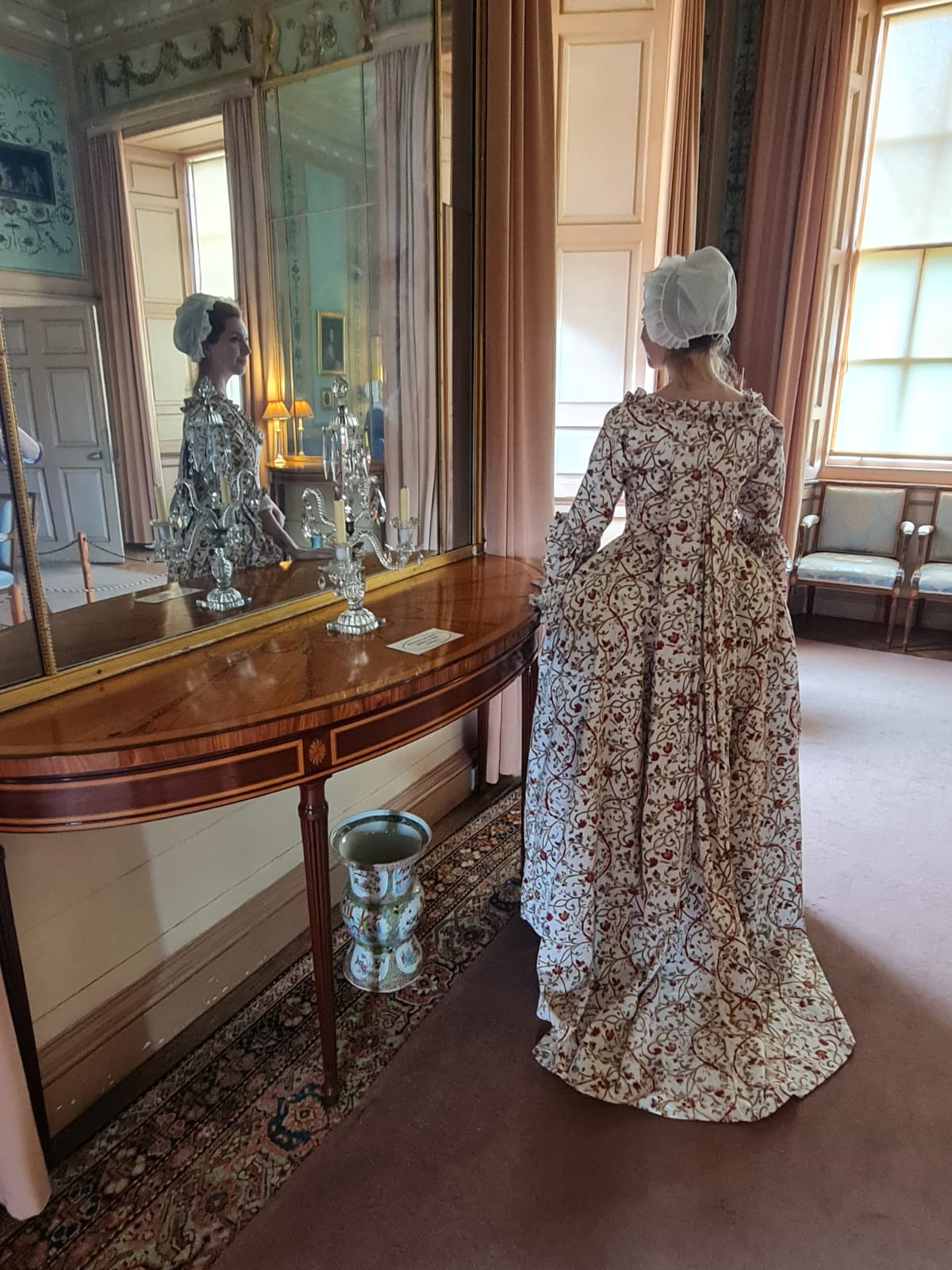
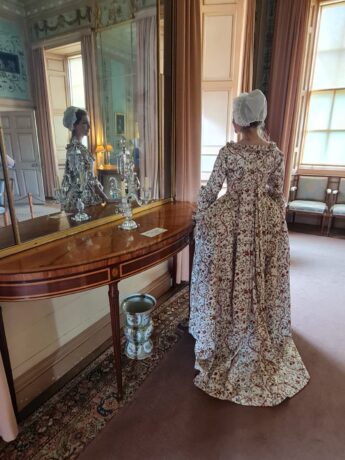
One of the most fun projects we have staged at Paxton House was our Georgian Dressmaking Live! when two talented University of Glasgow students of textile history spent a week in our Picture Gallery painstakingly constructing a Georgian gown using traditional techniques. As visitors stopped to watch, the knowledgeable students had chance to explain, not just what they were doing, but also details about the fashions of the 1770s from caps and shoes to dresses. They discussed the lifestyles of dressmakers or mantua makers in Georgian Scotland and explored some of the life of Penelope Home, the owner of Paxton House, who probably owned dresses just like this one.
The finished project, a fashionable sackback dress made of lightweight printed Indian cotton, is now on display in the Drawing Room and will be seen by everyone who books a tour of Paxton House. We recorded part of the project on film and have just posted two videos which review the project in full, breaking down the construction of the dress day by day before its final completion and modelling. Watching Cait wearing the dress and walking through the rooms at Paxton, just as Penelope Home must have done, really bring the house and the period to life. You can watch the videos here on our Conservation Stories web page.
Go to Conservation Stories
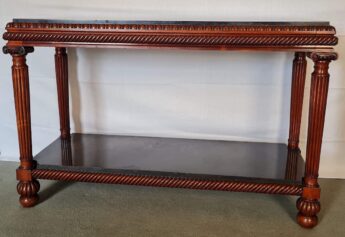
Regular visitors to Paxton House will notice a new table standing in the Library. Actually, it is a ‘lost ‘ table, one which was commissioned for Paxton House in 1813 but which was re-acquired from a private collector. We are very excited that we have been able to re-acquire the table with the help of the National Fund for Acquisitions, the Art Fund and a private donor. The table is a part of Paxton House’s exceptional collection of the furniture of Scottish cabinet maker, William Trotter, which was commissioned by owners, George Home and his ward, Nancy Stephens, to furnish their newly completed extension to the house.
From Lobby to Library
The table’s design tells us that is was originally a lobby table. The most successful part of William Trotter’s business was designing furniture for the houses being built in the New Town of Edinburgh. A table of this type allowed visitors to leave their cards in the hall when they came to call if the house owner was out. In the busy social life of Edinburgh in the Regency period, a lobby table played an important role in regulating meetings between friends. Our table has always been multi-functional and the historic inventories in the archive tell us that it has been used in different rooms in the house through the centuries. Now in the Library, this piece of furniture allows the study and display of some of the large books that fill the shelves.
Commissioning the Table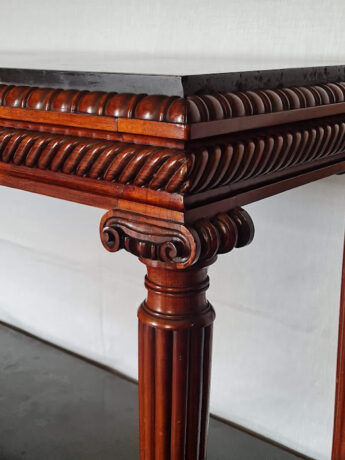
The table is of rosewood ornately carved in a manner typical of William Trotter, who is considered Scotland’s premier cabinet maker. At Paxton, it is reunited with other Trotter furnishings in the Library and Picture Gallery. This collection of 40 items of furniture from settees to library steps is the most important collection of furniture by William Trotter and was his largest country house commission. We know that Trotter and his wife visited Nancy Stephens at Paxton House in 1813 to discuss the materials and design of this significant commission. This table, and two others in the Picture Gallery, were designed to show off the fine hard stone tops collected by George Home’s uncle Patrick in Italy in the 1770s, making this table completely unique. It was shipped from Edinburgh to the port at Berwick-upon-Tweed in 1814 and carried by horse and cart to Paxton House.
Why commission the table?
George Home was a lawyer and a writer to the Signet (responsible for documents that carried the royal seal) based in Edinburgh. As a busy lawyer and a single gentleman, his ward, Nancy, was in charge of running his country house at Paxton. Together, they planned the only addition to the 18th century house, built by George’s uncle Patrick. After Patrick’s death, George inherited his collections of books and works of art and needed more space to display them. The huge Picture Gallery at Paxton is still the largest in any country house in Scotland and today displays part of the collection of the National Galleries of Scotland. The Picture Gallery was seamlessly linked to the rooms of the main house by the new Library and Bust Room and the complete set of furnishings from William Trotter’s workshop create a unified design.
The lobby table is now beautifully restored, thanks to grants from the Pilgrim Trust and a private donor. We are proud to be able to share this exquisite piece of furniture with our visitors, an important piece of Scottish design and with so much to tell us about life in Scotland at the start of the nineteenth century.



Donate here.
April is the month for daffodils at Paxton House! Swathes of cheerful yellow flowers fill the meadow at the entrance of the house and there are lots of different varieties in the gardens and grounds. In the gardens the range of different daffodils of all sizes are set off by blue Pulmonaria and the first scarlet tulips. They are bringing us all good cheer now the house and grounds are both open daily.
The pheasant eye narcissus is the nearest variety to the original Mediterranean daffodil, immortalised in the Greek myth of self-obsessed youth, Narcissus, who fell in love with his own reflection. It’s Latin name is Narcissus poeticus, so it is also known as the Poet’s Narcissus. Perhaps it will inspire you with a verse or two or perhaps you prefer the out and out vulgarity of our grand large sulphur-yellow daffodils. TV naturalist Chris Packham recently called the brightest daffodils ‘naffodils’ but we love their cheery colour and bold shapes. Come and enjoy our hosts of golden daffodils for yourself.
We are thrilled to have received support from Museums Galleries Scotland for the next phase of our Caribbean Connections project.
What the grant is for
Paxton House will receive funds as part of Museums and Galleries Scotland’s Delivering Change Sustainable Co-production Fund, made possible thanks to players of the National Lottery and People’s Postcode Lottery. The fund supports learning and co-operative curation with communities that have been systemically excluded from decision making. The objective is to find ways to create learning as a two-way process and to empower people to make decisions about their cultural lives.
Sheila Asante, Delivering Change Programme Manager, Museums Galleries Scotland said, “We’re delighted to support Caribbean Connections Creative Partnership at Paxton House. Their project focuses on working together with different groups and communities to create relationships that promote longevity, power sharing, and equity. Building these relationships will support more people to access and participate in heritage through Paxton House.”
What we plan to do
The grant will allow us, at Paxton House, to continue to develop our highly successful Caribbean Connections Creative Partnership with our partners, Descendants. Our project aims to inspire a sense of pride and accomplishment in the young people and older generations of the communities with whom we co-operate. We will build upon our award-winning work with Descendants and our local community in new sustainable ways to co-create long-term educational resources, new partnerships, and develop the skills of all involved through training, workshops, an exhibition, and events.
What to expect
We plan to bring together internationally-renowned Grenadian artist, Billy Gérard Frank, Edinburgh Caribbean Association, Grenadians, and local communities to make innovative artwork and heritage resources available for local and global audiences. It is a chance for us to explore the links between Paxton House, the Home family and Grenada from 1764, when Ninian Home first purchased a plantation in Grenada, to the present day. So far the programme has resulted in rich new research and resources and a new understanding of the place that Paxton House, as a gentleman’s country house in Britain, holds in the history of the slave trade. Our co-operation with Descendants has brought new understanding to the families that are part of the African Caribbean diaspora and new audiences to Paxton House.
Professor Louise Jackson, Chair of The Paxton Trust, said, ‘We are delighted to have received support for this ground-breaking project, which combines our curatorial, public engagement and education remits to diversify our audiences, and look forward to sharing the outcomes”
Find out more about our Caribbean Connections and about Descendants.

Image from Caribbean Connections Celebration Day 2022 at Paxton House
Even when we get snow flurries in the gardens at Paxton House, nothing deters the bright flowers of crocuses. Our favourites this year are the blue Crocus vernus “Flower Record”, which we grow in profusion naturalised into the lawns on the South Front of the house. They spread naturally as the corms divide underground and our display has taken years to establish. They thrive in the lawn before the trees start to put out leaves, making the most of the lengthening Spring days, we just have to be careful not to mow down the leaves before the corm has a chance to replenish its nutrients for next season.
Book your gardens ticket here
One of the most eye-catching portraits in the Picture Gallery at Paxton House is a full length portrait of a dark haired girl in a red coat with a fan. It’s a wonderful image but who is she?
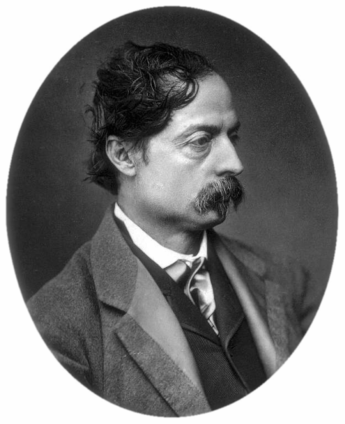
She is Ellen Moxon, painted in 1872 when she was just 18 and newly engaged to the man who was to become her husband, William Quiller Orchardson. Orchardson was a painter, born in Edinburgh and just forging his career in London where he had lived since 1862. When they met he was newly returned from Venice from where he had had to dodge the disruption of the Franco-Prussian War to make it safely back to England.
William Quiller Orchardson
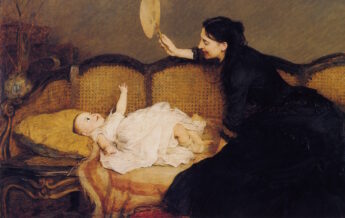
The portrait of Ellen shows his skill in capturing character and the influence of Japanese prints on artists at the time but he was to make his name as a painter of restrained domestic studies with limited colour, self conscious arrangement and sentimental themes. By 1877 he was a full member of the Royal Academy and by 1881 was one of the most popular painters in London.
Master Baby by William Quiller Orchardson, 1886
Ellen has, like so many Victorian women, slipped into historical obscurity. The marriage was happy and they went on to have four sons and two daughters. Luckily for us, we get tiny glimpses of her life through her husband’s work. We see her playing with one of their children in charming study from 1886 entitled Master Baby and see the drawing room of the family house in Portland Place in Her Mother’s Voice. The room is fashionable for the period and furnished in the Empire style that suited Orchardson’s scenes of upper class married life.
Of their seven children, only Celeste, born in 1876, died before she left infancy, the other six grew up to outlive their parents. William Quiller Orchardson was knighted in 1907 and died in 1910, still painting, at the age of 78. Lady Ellen lived on until May 1917, suffering the tragedy of the death in the First World War of her eldest son, Charles, who was also a painter and married with two children. His death was less than a month before her own. She left the portrait of herself as a girl, among other works, to the National Gallery in Edinburgh and portraits of her parents, Mr and Mrs Charles Moxon, to the Tate.
Paxton House reopens to the public on 29th March this year. Book here.
There is always special time in the year when the snowdrops just seem to get on with being gorgeous. We thought you should know that Paxton House Gardens is full of snowdrops now, like tiny dancing ballerinas hiding in the corners of the beds and under the trees. Snowdrops are such special little harbingers of Spring and though they are hard to establish, in an old garden like Paxton they have had decades to develop into drifts of pure white which seem to glow in dull weather. Come before the end of the month to catch an amazing display of these shy little flowers before they give way to gaudier delights as Spring takes hold.
Buy a grounds pass here.
Celebrate 50 years of independence in Grenada with our special rum punch.
Ingredients
50ml light or golden rum
150ml pineapple juice
50ml orange juice
1 tbsp fresh lime juice
1 tbsp sugar syrup
dash of angostura bitters
nutmeg, the national spice
Method
Stir together all the ingredients, except the nutmeg, and chill. Strain into a long glass and serve over ice cubes, sprinkled with grated nutmeg, garnished with an orange twist and a maraschino cherry.
Ninian and Penelope Home would have drunk punch in the 1760s although theirs was probably a little simpler – perhaps just rum, citrus juice, sugar and water and though Grenada is famous for nutmeg today, it wasn’t introduced to the island until 1849. If you prefer, Paxton House’s recipe also tastes good without the rum.
Thanks to the Grenada Co-operative Nutmeg Association for inspiring our rum punch recipe.